
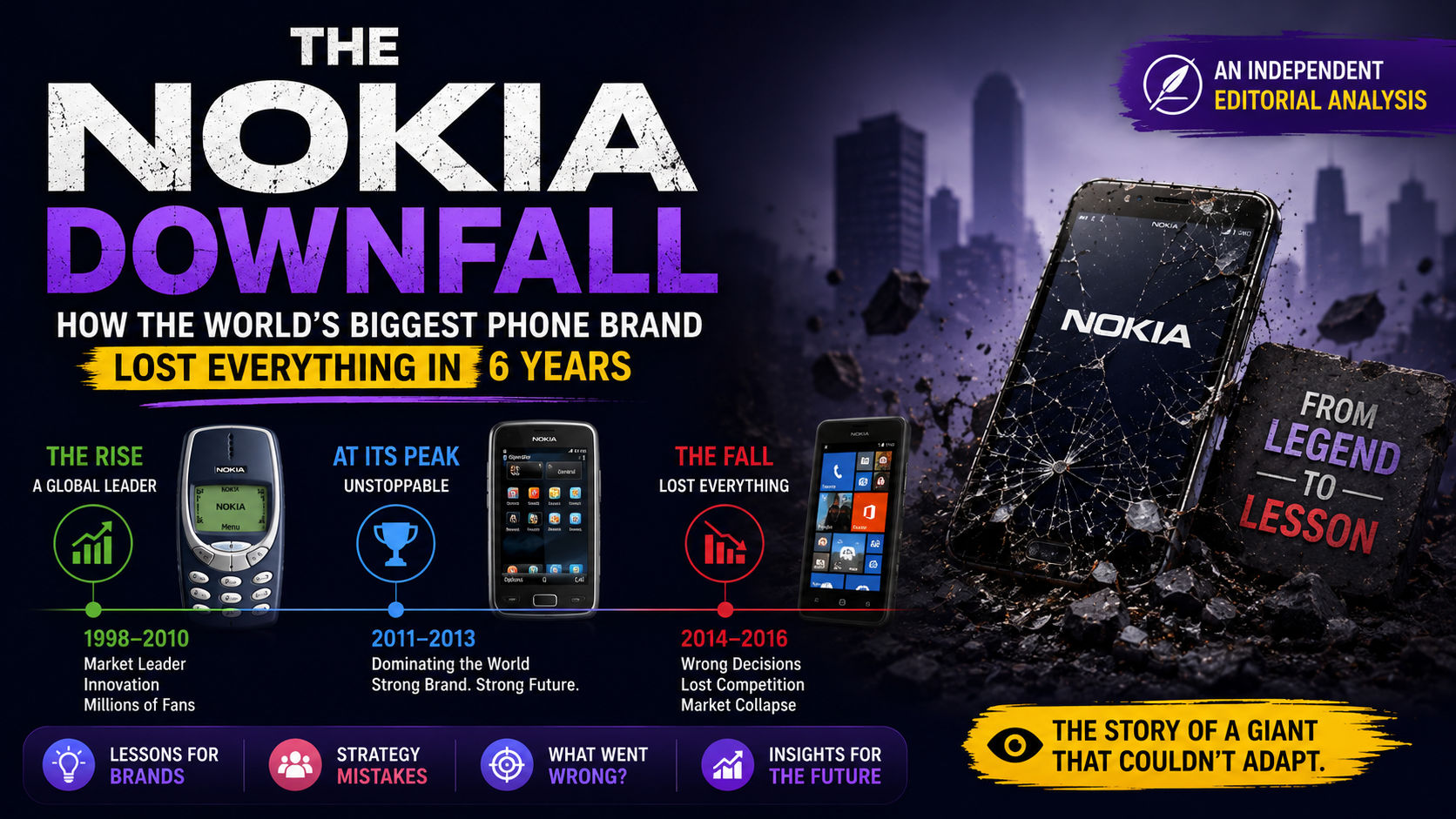
The Nokia Downfall: How the World's Biggest Phone Brand Lost Everything in 6 Years
Nokia once controlled 40% of the global phone market. Six years later, it was gone. Here's the real, data-backed case study of what killed Nokia — and what every gadget brand can learn from it.
Introduction: The Brand That Ruled the World... Until It Didn't
Any mobile phone purchased between 2000 and 2010 had a single name on it — Nokia. From the indestructible Nokia 3310 to the best-selling device ever, the Nokia 1100, which outsold iPods, nothing could rival Nokia's success. In 2007, it controlled the largest slice of the world market (40%), almost double that of its nearest competitor.
However, the next significant event for the company changed everything: the arrival of the revolutionary iPhone in 2007. Within just six years, Nokia's most profitable division was sold to Microsoft for a fraction of its former worth.
This fall from the heights of the industry is one of the most famous cases in the business world, often cited in teaching materials at graduate business schools. What exactly led to the downfall of Nokia? Let's take a look at the critical errors that caused the collapse of this giant, step by step.
1. Nokia Did Not Underestimate Smartphones — It Simply Did Not Understand Them
Nokia did not dismiss smartphones as a novelty; the company had already launched several promising projects of its own. The problem was that in its race to release products, Nokia did not put enough effort into perfecting the existing solutions. As a result, a very high barrier formed for would-be competitors from within: Symbian OS, which Nokia had developed specifically for simple, intuitive use, could not keep up with the rapid evolution of app-driven interfaces.
When the iPhone was presented in 2007, Nokia executives apparently did not perceive it as a serious threat to their market dominance, largely because its interface lacked a physical QWERTY keyboard. This judgment backfired badly, because it completely failed to account for the impending shift in how users would interact with technology.
2. The Irresistible Force Meets the Immovable Object: Symbian
Symbian was a huge success — hundreds of millions of devices ran on this OS, which was more than sufficient for the technical capabilities of Nokia phones at the time. But that success became the reason for its downfall, because the company was unwilling to give up such a profitable product. Meanwhile, Apple's iOS and Google's Android (released in 2008) offered a far more promising path forward for both manufacturers and users.
In its efforts to keep up with the times, Nokia kept releasing updated versions of Symbian — but few developers were willing to build for it, largely due to how complex the platform was to program for and its lack of an intuitive developer interface. As a result, the quality of apps in the Symbian store suffered significantly, which in turn made Nokia smartphones far less appealing to buyers.
3. The Burning Oil Platform and a Shocking Decision
The famous Nokia memo, written in February 2011, marked the beginning of the end for the Finnish giant. New CEO Stephen Elop — a former Microsoft executive — showed remarkable candor when he sent an open letter to all employees. He compared Nokia's situation to a man standing on a burning oil platform, forced to jump into freezing water below just to survive.
The memo captured deep frustration and laid bare why Nokia had failed to keep pace with the industry. Just days later, Elop announced a decision that shocked the industry: Nokia would abandon Symbian OS entirely and sign an exclusive deal with Microsoft for the Windows Phone platform — instead of adopting Android, which was already gaining massive momentum.
Most business analysts see some logic in this decision, since Nokia simply didn't have time to build an OS that could rival the capabilities of iOS and Android from scratch. But the choice of the Microsoft ecosystem baffled many observers, since Windows Phone occupied a tiny market niche at the time and had very few apps. Nokia's legacy as a technology leader remains inseparable from the memory of the burning oil platform memo — and the fateful decision to turn away from Android.
4. The Curse of No Apps: How App Stores Sealed Nokia's Fate
By 2010, the world had fully entered the smartphone era. The iPhone had proven itself, and apps had become essential to the mobile experience. But Nokia executives underestimated just how much power apps — and developer attention — would hold over the market. When the Lumia series, running Windows Phone, launched in 2011, it lacked many of the apps consumers had come to expect.
The Windows Phone app store was significantly weaker than its iOS and Android counterparts, simply because developers focused their efforts on the two platforms with the largest user bases. It became a vicious cycle: apps didn't appear because there weren't enough users, and users didn't come because there weren't enough apps.
5. Internal Politics and Slow Decision-Making
Another major factor in Nokia's downfall was an internal culture that struggled to admit its own weaknesses. According to various researchers and former employees, internal politics at Nokia stifled innovation and slowed down decision-making. Middle management was reluctant to publicly criticize the company's own technology, creating an acute shortage of honest dialogue on issues that mattered most. Researchers writing in the Academy of Management Journal in 2014 concluded that this culture directly contributed to Nokia's delayed response to the smartphone shift.
It's also worth noting that former Nokia employees have said the company came close to building a genuinely competitive smartphone product on multiple occasions. Engineers were ready — but internal resistance and a reluctance to embrace a new approach held them back from shipping a truly competitive flagship. Had things gone differently, Apple's own rise might have looked very different too.
6. Nokia's Final Descent and the Sale to Microsoft
Despite its early dominance, by 2013 Nokia's market share had collapsed to single digits. In September 2013, Microsoft purchased Nokia's phone division for €5.4 billion. Just two years later, Microsoft discontinued Nokia-branded smartphones altogether. The Nokia name lives on today, however, through a licensing agreement with HMD Global, which now makes Android smartphones under the Nokia brand.
What Can We Learn From the Downfall of Nokia?
| 1. Didn't anticipate the iPhone as a serious competitor | 1. Never ignore shifts happening in your market |
| 2. Clung to Symbian for too long | 2. What brings success today won't guarantee success tomorrow |
| 3. Chose the wrong partner in the race against Android | 3. Focus on consumer needs, not internal convenience |
| 4. Inefficient internal organization | 4.Build honest, effective communication at every level of the hierarchy |
| 5. Lack of apps in the store | 5.A smartphone is only as good as the apps that run on it |
Summary: The Nokia Case Study in 2026
Nokia's story is one of the most compelling cases in business history. Although it was once one of the most influential tech giants in the world, the company failed to understand how quickly its market was changing. Fortunately for Nokia as a business, this didn't lead to total collapse — but the reputation of the once-mighty giant suffered significantly.
The most important lesson from this story is simple: no matter how confident a company is in its products, it must always stay prepared for a surprise challenge from a new entrant. After all, in just six years, one of the most influential companies in the world was forced to sell the majority of its mobile technology to another giant.